Limited crack repair
A bounded crack-repair scope. The proposal should state the material, preparation, accessible length and finish work—and must not use price alone to classify the crack.
Scope dictionary · July 2026
A method name is the beginning of a comparable scope—not a diagnosis, design or complete price. Use this guide to translate proposal language into measurable questions.
No. 01 — Direct answer
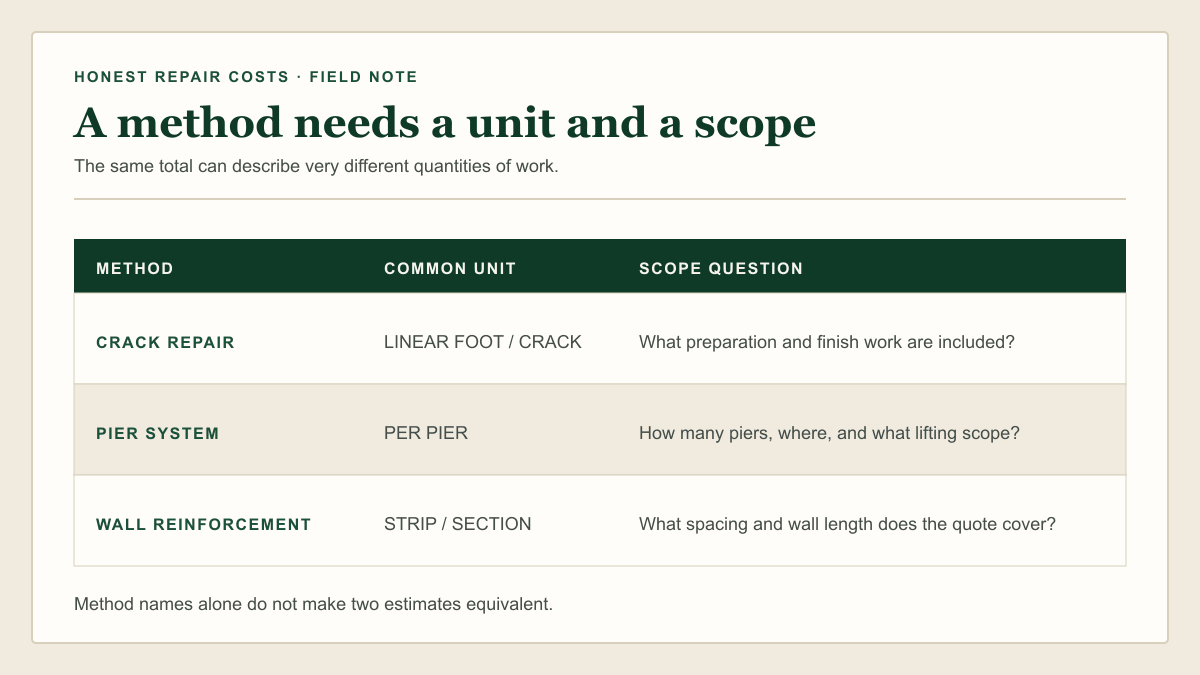
Foundation proposals often use a recognizable method name while leaving out the measurable scope. Before comparing price, ask what the method is intended to do, how much work is proposed, which unit controls the price and what remains excluded.
A familiar repair label can still hide a non-comparable scope.
No. 02 — Method dictionary
A bounded crack-repair scope. The proposal should state the material, preparation, accessible length and finish work—and must not use price alone to classify the crack.
Material is introduced beneath a slab to lift or support a defined area. Ask for the area, material, void assumptions and intended objective.
A driven support system commonly priced per installed pier. The system, layout, count, termination criteria and included site work should be written.
A screw-like support system with its own design and installation assumptions. Do not silently substitute a combined national pier range for a method-specific bid.
Carbon-fiber, steel or anchor-based proposals may use different units. Ask for wall length, number of strips, beams or anchors, preparation and water-management boundaries.
A broader structural scope that adds or extends support beneath an existing foundation. The term should resolve into a system, quantity, sequence and project boundary.
Temporary support, demolition and rebuilding of affected foundation elements. Utilities, waterproofing, inspections and restoration need explicit ownership.
No. 03 — Units
Useful only when two proposals describe the same bounded work, inclusions and restoration.
Requires a documented system, quantity and definition of what installation includes.
Must define wall length and the number of strips, beams or anchors. A section is not automatically a single item.
No. 04 — Proposal test
Ask for documented conditions without treating a sales label as an independent structural conclusion.
Stabilization, lifting, water management and finish repair are different outcomes.
Pier count, wall length, strip count, area or project boundary should make the quantity auditable.
Inspections, utility checks, cleanup, restoration and monitoring should not appear only after work starts.
The calculator estimates a method you select. It never selects the method for the house.
For a major structural commitment, consider review by an appropriately licensed professional who does not sell the repair.
No. 05 — Evidence
Source date 2024-01-01; verified 2026-07-26. Evidence class: official-code; family: icc. Technical context for foundations, soil, drainage and waterproofing. It does not publish repair-cost multipliers; local adoption varies.
Source date 2024-01-01; verified 2026-07-26. Evidence class: official-code; family: icc. Technical context for underpinning design and sequencing. It does not publish repair-cost ranges.
Source date 2026-03-06; verified 2026-07-26. Evidence class: editorial-market-data; family: angi-homeadvisor. Editorial presentation derived from Angi cost data. It is not an independent price-data family.
Source date 2026-02-06; verified 2026-07-27. Evidence class: market-data; family: homeguide. Independent proprietary cost-database comparison. Several scopes differ from the runtime claims, so overlap alone does not make a range supported.
For prices, units and evidence grades, use the full foundation cost guide.
No. 06 — Questions
Common proposal terms include limited crack repair, slabjacking, push or hydraulic piers, helical piers, bowed-wall reinforcement, underpinning and full replacement. These labels describe work categories; they do not establish which method a property needs.
No. They are different support systems even when both are priced per installed pier. Ask the proposal to identify the system, design assumptions, layout, quantity and included work.
Do not assume it does. Structural reinforcement, crack repair, drainage and waterproofing are separate scopes unless the proposal explicitly combines and itemizes them.
No. The calculator estimates a method and quantity selected by the user. It does not inspect the property, determine a cause or design a repair.
No. 07 — Keep reading
Use the calculator for a method-based range, then use these guides to make the scope comparable.
Compare method-specific slab repair units without treating every slab problem as one repair.
Read the guide →GUIDE / 02Understand the installed per-pier unit, engineered quantity and local permit-valuation context.
Read the guide →GUIDE / 03Separate temporary support, demolition, rebuilding and restoration in a full replacement scope.
Read the guide →