System
Ask whether the proposal uses a push, hydraulic, resistance or helical system and why that system matches the documented scope.
Foundation cost unit · July 2026
A per-pier price is useful only when the pier system, engineered quantity and included work are all stated. Start with the unit—then build the project total.
No. 01 — Direct answer
The national evidence supports a planning range for one installed hydraulic or steel pier. It does not supply the number of piers your house needs, and it does not guarantee that engineering, excavation, permits or restoration are inside the same unit price.
Claim foundation.pier · Evidence supported/medium. The per-pier unit is supported across multiple families; total scope still depends on an engineered quantity.
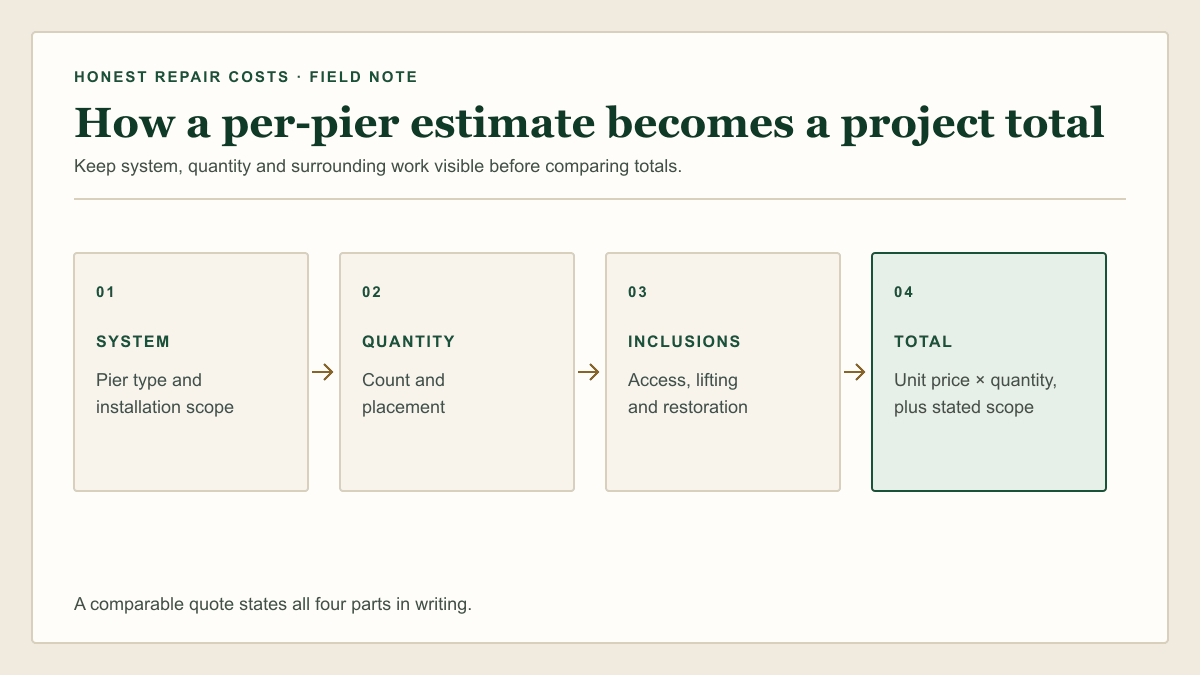
Use the foundation calculator only after the proposed quantity is documented. Multiplying by an assumed count creates precision without a verified scope.
No. 02 — Unit scope
Two identical per-pier numbers can still produce very different contracts.
Ask whether the proposal uses a push, hydraulic, resistance or helical system and why that system matches the documented scope.
The plan should state the pier count and layout. A sales total without a measurable quantity cannot be compared per pier.
Engineering, mobilization, excavation, lifting, plumbing checks, permits, cleanup and finish restoration may sit outside the unit.
No. 03 — Local research
The samples below preserve method and unit, but they remain declared permit valuations from one upstream municipal family.
Local permit-valuation context
Separate from the national estimate above. These are declared permit valuations divided by an explicit reported quantity—not invoices, verified installed costs or a recommended price.
Quantity-scaled permit valuation · 1 helical pier
$1,773–$2,327
Scales the helical-pier permit distribution by the entered pier count; it does not change the combined national pier line.
The local sample is helical-pier specific. It is not a direct match for the calculator's combined hydraulic-or-steel-pier line. Sample window: July 27, 2024–July 27, 2026. Sources: Shovels; City of Raleigh. Read the evidence limits →
Local permit-valuation context
Separate from the national estimate above. These are declared permit valuations divided by an explicit reported quantity—not invoices, verified installed costs or a recommended price.
Quantity-scaled permit valuation · 1 push pier
$2,462–$2,650
Scales the push-pier permit distribution by the entered pier count; it remains separate from the national estimate.
The official current-year comparison is directional because its window and record grain differ from the two-year research sample. Sample window: July 27, 2024–July 27, 2026. Sources: Shovels; City of Sacramento. Read the evidence limits →
No. 04 — Cost drivers
Clarify whether evaluation, design, elevations, load assumptions and follow-up documentation are included.
Ask where equipment and crews must work and which landscaping, concrete or interior finishes must be opened and restored.
Stabilizing further movement and attempting elevation recovery are not automatically the same scope.
Permit inspections, plumbing checks, patches, cleanup and warranty documents should be assigned in writing.
No. 05 — Before comparing totals
No. 06 — Evidence
Source date 2026-03-17; verified 2026-07-26. Evidence class: market-data; family: angi-homeadvisor. Primary upstream cost survey used for national, method, issue, engineer-report, permit and labor ranges.
Source date 2026-07-10; verified 2026-07-26. Evidence class: market-data; family: angi-homeadvisor. Primary upstream source for underpinning, pier counts, project labor and permit ranges.
Source date 2026-02-06; verified 2026-07-27. Evidence class: market-data; family: homeguide. Independent proprietary cost-database comparison. Several scopes differ from the runtime claims, so overlap alone does not make a range supported.
Source date 2024-11-26; verified 2026-07-27. Evidence class: market-data; family: homeguide. Reports $10,000–$30,000+ for underpinning and $1,000–$3,000 for a single pier using a proprietary estimate database and editorial review.
Source date 2026-07-14; verified 2026-07-27. Evidence class: vendor-information; family: municipal-permit. Aggregates municipal permit records. API job_value is reported in cents and was normalized to dollars. It is a jurisdiction-reported valuation, not an invoice or verified installed cost. Raw responses and identifying fields are not retained.
Source date 2026-01-01; verified 2026-07-26. Evidence class: official-local; family: city-of-raleigh. The official allowlisted audit reviewed 71 records and directionally confirmed the helical-pier permit sample. Official and aggregated records remain one municipal upstream family; no regional price factor.
Source date 2026-01-01; verified 2026-07-26. Evidence class: official-local; family: city-of-sacramento. The v3 target reviewed 125 records and retained 49 push-pier observations with explicit counts. The official current-year comparison is directional; permit valuations are not used as a cost factor.
No. 06a — Questions
The reviewed national planning range is $1,000–$3,000 for one installed hydraulic or steel pier. A project total still requires a documented pier count and a clear list of included site work.
Not necessarily. The national line combines published hydraulic-or-steel-pier evidence, while the local research samples distinguish Raleigh helical piers from Sacramento push piers. The systems should not be treated as interchangeable without matching scope.
No. A permit valuation is a declared administrative value, not an invoice or verified installed price. It is shown only as separate local context and never changes the national calculator result.
A cost guide cannot determine a structural quantity. Ask for the observed condition, proposed system, layout and pier count in writing, and consider independent professional review before a major commitment.
No. 07 — Keep reading
Use the calculator for a method-based range, then use these guides to make the scope comparable.
Review U.S. foundation underpinning costs by project scope, pier system, quantity, engineering and restoration.
Read the guide →GUIDE / 02Learn what common foundation repair terms describe and which scope questions they leave unanswered.
Read the guide →GUIDE / 03Turn a lump-sum proposal into comparable method, quantity, site-work and contract questions.
Read the guide →