Observed condition
The document should distinguish observations from diagnosis and state what information supports the proposed scope.
Quote anatomy · July 2026
A total is not a scope. Turn the proposal into six readable parts before deciding whether two estimates describe the same work.
No. 01 — Direct answer
The Federal Trade Commission recommends getting written estimates and understanding the contract before work begins. For foundation repair, the most useful written estimate connects method, quantity, site work and commercial terms without letting one substitute for another.
Price becomes meaningful after the scope becomes measurable.
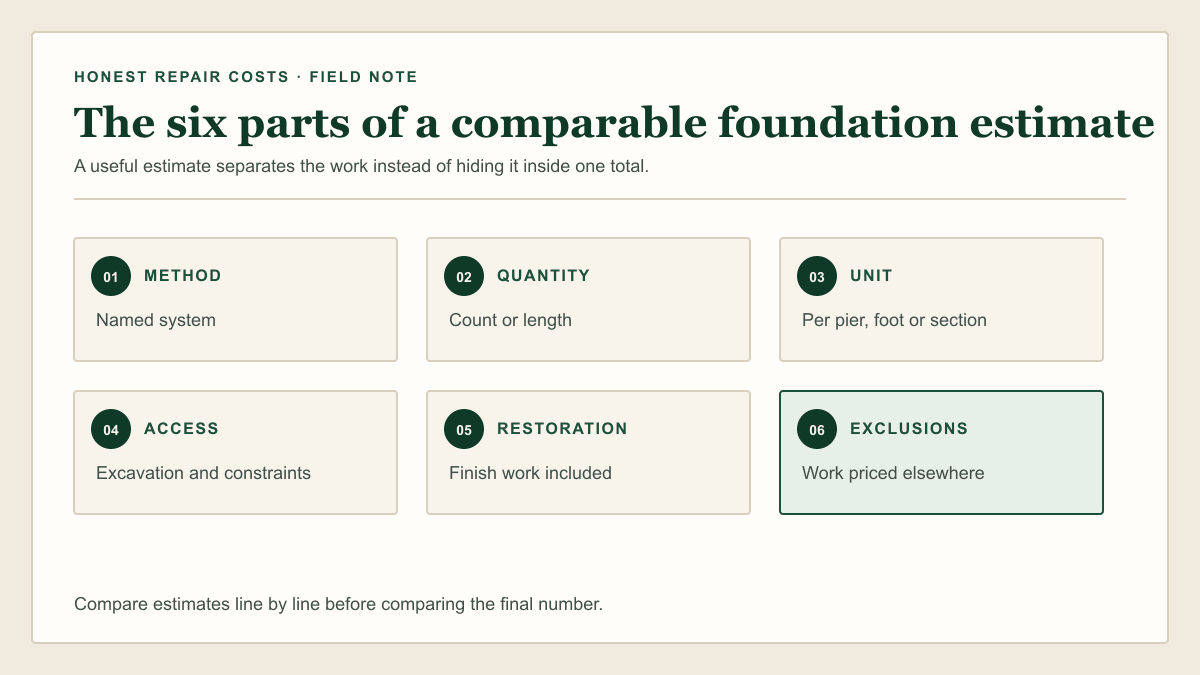
No. 02 — Six-part breakdown
The document should distinguish observations from diagnosis and state what information supports the proposed scope.
Name the repair system and whether the objective is limited repair, stabilization, lifting, water management or replacement.
Pier count, wall length, reinforcement count, area or a bounded project scope should explain how the price was assembled.
Assign evaluation, design, permits, plan review, inspections and closeout documents without assuming one national rule.
Access, excavation, protection, utilities, cleanup, concrete, finishes and landscaping should be included or excluded explicitly.
Schedule, payments, financing, warranty, cancellation and change orders should remain separate from the technical justification.
No. 03 — Normalize bids
A per-pier proposal cannot be compared with a lump-sum underpinning scope until system, quantity and boundaries align.
Engineering, permits, lifting, utilities and restoration can explain a difference that looks like price.
Financing and warranty can matter, but they do not establish that the method or quantity is appropriate.
No. 04 — Written checklist
Then use the Quote Checker to place the normalized bid against the same method-based planning range.
A missing line item does not disappear. It usually becomes an assumption or a change order.
Local contract and permit rules vary. This checklist is general consumer guidance, not legal or engineering advice.
No. 05 — Evidence
Source date 2026-01-01; verified 2026-07-26. Evidence class: official-consumer-guidance; family: ftc. Supports written-estimate, contract and payment checks. It does not support a fair-price threshold.
Source date 2026-01-01; verified 2026-07-26. Evidence class: official-licensing; family: ncees. Directory for the relevant state engineering licensing authority; it does not provide price data.
Source date 2026-01-01; verified 2026-07-26. Evidence class: official-local; family: city-of-austin. Official local example showing why permits cannot be represented by a single national automatic add-on.
Source date 2026-01-01; verified 2026-07-26. Evidence class: official-local; family: city-of-tampa. Foundation-specific permit, engineering documentation and inspection requirements. No regional price factor.
No. 06 — Questions
A useful estimate identifies the observed condition, proposed method, measured quantity, pricing unit, engineering and permit responsibility, access and site work, exclusions, restoration, schedule, payment terms, warranty and change-order process.
Normalize them to the same method, quantity and project boundary. Then compare engineering, permits, excavation, lifting, utilities, cleanup, restoration and warranty terms before comparing the total.
No. Requirements and fee bases are local. Honest Repair Costs keeps permit information separate and never adds a universal permit amount automatically.
No. It may describe less work or defer items to change orders. Ask for measurable quantities, written exclusions and a process for unforeseen conditions before treating totals as comparable.
No. 07 — Keep reading
Use the calculator for a method-based range, then use these guides to make the scope comparable.
Review pressure, unclear scope, credentials, financing and written-contract concerns.
Read the guide →GUIDE / 02Learn what common foundation repair terms describe and which scope questions they leave unanswered.
Read the guide →GUIDE / 03Understand the installed per-pier unit, engineered quantity and local permit-valuation context.
Read the guide →